Coloured Gemstone Jewellery

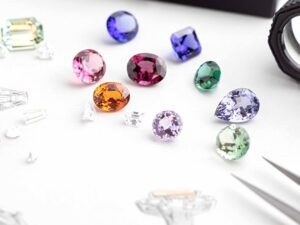
It is said the ancient Greeks believed that diamonds were the tears of God.  But for those who want to add a touch of colour to their outfit there are other precious stones that can be just as spectacular.  An exciting array of choice awaits those who would like to take a step away from the traditional and delve into the rich sea of coloured gemstones we have today. For thousands of years, coloured gemstones have piqued the interest, desire and greed of kings, pirates, men and women all over the world. Although diamonds have become a timeless icon for women and men everywhere, these days many coloured gemstones are used to create unique and eclectic jewellery.  Emeralds, Sapphires and Rubies enjoy being the three most popular coloured gemstones in the world.  But other stones such as Peridot, Amethyst, Citrine, Aquamarine, Garnet and many others can be just as striking. As with diamonds, the majority of coloured gemstones are also graded and priced in a similar way - based on colour, cl ...

The Oval Cut

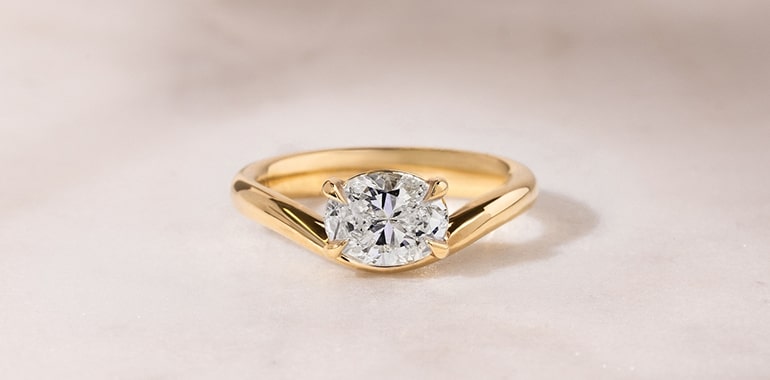
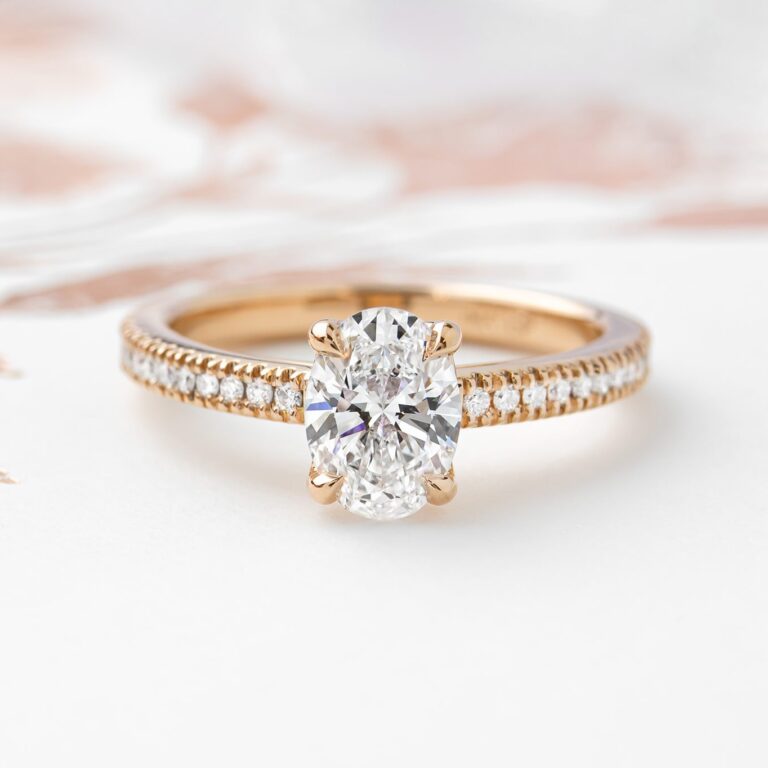
The oval cut is a variation of the round brilliant cut and is considered a very traditional cut.  This shape appeals to people looking for a stone that is traditional in appearance but not too common.  Oval cut diamonds only account for a small proportion of all diamond sales.

The oval cut has the same number of facets as the round brilliant cut.  A well proportioned oval cut diamond should not be too short and squat, or too long and skinny.  Most experts agree that the length should be around one and a half times the width.

One of the benefits of the oval cut is that, like the marquise cut, it makes the finger appear more slender.  However, unlike the marquise cut, the oval cut has broader appear given its more traditional shape.

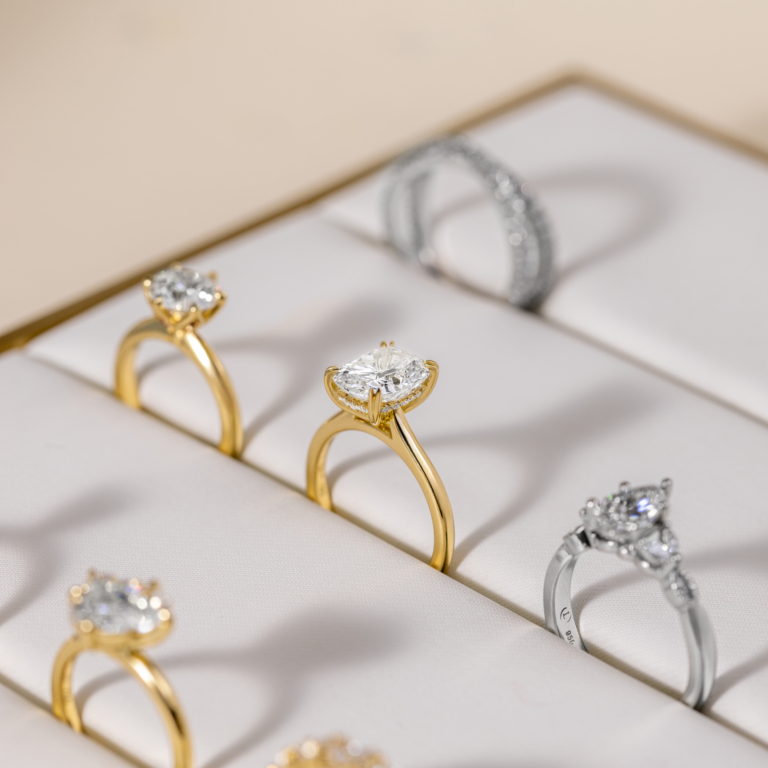
An oval cut diamond does however present some design challenges as it can be difficult to match with other shapes of diamonds.  In engagement rings, oval cut diamonds are typically set as solitaires, or teamed with other oval cut stones or contrasting cuts like tapered baguettes.

Click here to view a selection of oval cut diamond engagement rings.

Round Brilliant Cut Diamonds

The round brilliant cut is by far the most popular diamond cut for engagement rings and most other types of jewellery.  This type of cut accounts for around 75% of all diamonds sold.

Known for its superior sparkle, the round brilliant cut is generally regarded as the most optically spectacular of all cuts.  Today's brilliant cut is comprised of 58 facets.  The cut was developed over time with the first prototype having been traced back to the beginning of the 15th century.  The term "brilliant cut" was not a normally used term for some time with the first recorded use dating back to 1614.

In 1919, Marcel Tolkowsky, a mathematician from Antwerp, analysed the proportions of the brilliant cut and came up with a mathematical formula for how to cut a round brilliant cut in a way that would maximise the brilliance (the amount of light reflected) and fire (flashes of spectral colour).  Different versions of this style became known as the Tolkolsky Cut and the Modern Brilliant Cut.

Click here to read more about different diamond shapes or to view a range of round diamond engagement rings.

Emeralds

Emeralds were first discovered in a collection of mines near the Red Sea in Egypt in what came to be known as Clopatra's emerald mines.  The first discovery of emeralds in Australia was in 1890 in New South Wales.

The word "emerald" derives from the Persian word smaragdus which means green.

Emerald belongs to the beryl family which also includes gems like aquamarine.  The colour of the highest quality emeralds is almost pure spectral green, sometimes with a faint touch of blue.  Emeralds derive their green colour from chromium and vanadium.

Emeralds are rarely found as clear crystals and often contain fine inclusions that are evidence of it being a natural stone.

Even though emeralds are a fairly hard stone, they can chip easily as they are slightly brittle.

Emerald is the birthstone for May and the 55th wedding anniversary gemstone.

Click here to view a few examples of emerald rings.

Sapphire Engagement and Wedding Rings

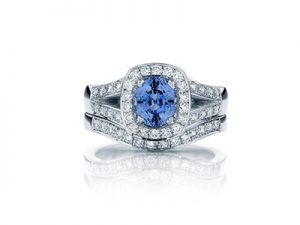
Sapphires are an increasingly popular choice in wedding and engagement rings.  Larsen Jewellery specialises in custom made jewellery and sells loose sapphires and other coloured gemstones.  Please click here to view a range of sapphire engagement ring designs.

Sapphires can be found in many different colours ranging from blue, which is the most common of its colours, to pink, orange, green and brown.  Sapphire is a form of corundum which is a colourless mineral formed from crystalised aluninium oxide.  The blue colour is created by different types of trace elements within the crystal.

Several explanations for the origins of the word "Sapphire" have been suggested with the most plausible being that it is derived from the Greek word Sappheiros, the name of an island in the Arabian Sea where the gem was mined in achient times.

Nowadays, sapphires are mined mainly in Sri Lanka, Thailand, Australia, Madagascar and Tanzania.  A sapphire's value is determined by its cut, colour intensity, consistency and purity.

Sapphire is the gemstone for the 5th and 45th wedding anniversary and is the birthstone of September.


Sapphire and Ruby Cuts

Sapphires and rubies belong to a gemstone family called corundum, also known as crystalline aluminum oxide.  As they both have the same chemical composition, their physical characteristics are very similar.  The presence of small amounts of trace elements however creates noticeable differences in colour.

Ruby is red corundum while sapphire can be all the other colours, including blue, green, pink, yellow, orange, purple and others.  As they share the same physical characteristics, a similar approach is taken to both when cutting the gemstones.

Perhaps more than any other type of coloured gemstone, rubies and sapphires are often cut to retain as much weight as possible, while still aiming to retain a pleasant shape.  Weight is important because rubies and sapphires can command prices in the thousands per carat.  Unfortunately this tendency can lead to stones that are disproportionately deep or overly shallow for their girdle size, and therefore lack brilliance due to light not being reflected up through the crown of the cut stone.  A well-cut stone should have pleasing proportions, good internal reflection and a symmetrical girdle regardless of the shape.

Both sapphires and rubies are well suited gemstones for jewellery.  They are tough stones, right behind diamonds on Moh's scale of hardness, and are therefore suitable for all types of jewellery, including engagement and wedding rings.

Please click here for a selection of sapphire engagement rings and sapphire wedding rings.

Coloured Diamonds

Diamonds can occur in virtually all colours of the spectrum, as well as milky-white, black and grey.  The two most commonly occuring colours, or hues, in diamonds are yellow and brown with yellow being by far the most prevalent.  Some colours are very rare, the rarest and most highly prized colour of all being that of red diamonds.

Coloured diamonds are graded according to their properties of hue (spectral colour), tone (lightness or darkness) and saturation (intensity).  In all cases, for any given hue, the greater the saturation the higher the value.

The GIA, recognised as the foremost authority on the grading of coloured diamonds, currently grades colour in nine different categories ranging from Faintly Coloured to Fancy Vivid Colour.  Argyle Pink Diamonds, Argyle Champagne Diamonds and Argyle Cognac Diamonds are graded according to a proprietary, in-house system developed by the Argyle Diamond Mines of Australia.

Click here for more information about Coloured Diamonds.

What is a Carat?

The word Carat is derived from the ancient words ‘Keration’ (Greek) and ‘Qirrat’ (Arabic), both of which were names given to the seeds of the Locust or Carob Tree.  Due to their relatively consistent size and weight, dried Carob seeds were once widely used by merchants as counterweights for weighing gold, diamonds, gemstones and pearls.

In 1913, after many attempts to standardise the weight of the Carat, the United States, United Kingdom and Europe adopted the use of the Metric Carat, which has become the standard unit of weight used throughout the diamond and gemstone industry today: 1 Carat = 0.2 Grams.

The Carat is further divided into Points, a unit of weight used only for diamonds: 1 Point = 0.01 Carat.

The size of a finished polished diamond is directly related to its Carat weight.  However, the actual dimensions are entirely dependent upon its proportions.

On average, a well proportioned 1 Carat round brilliant cut diamond has a diameter of approximately 6.5mm.  In comparison, a shallow cut diamond of the same weight may be anything up to 20% larger in diameter, whereas a deep cut diamond of the same weight may be as much as 20% smaller in diameter.

Please click here for more information about diamonds.

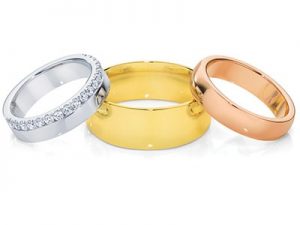
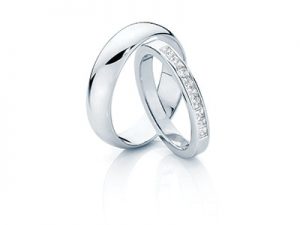
White Gold vs Platinum ... the eternal question

Your choice of metals comes down to a personal preference, but let me give you a run down of the main features of each so that you can make an informed choice for your rings.

In jewellery, platinum is used in its almost pure form with most alloys being 95% pure platinum, making it a very durable and dense metal.  It wears down at a much slower rate than other precious metals making it an excellent choice for engagement and wedding rings.  Platinum is roughly twice the density of gold per gram, which makes a platinum ring heavier than the same ring in white gold. Polished platinum has a natural greyish/white colour and maintains this throughout its lifetime.  It has a tendency to scratch more easily than white gold, however its strength makes for a longer lasting piece of jewellery. Platinum is more expensive than white gold because it is a rarer metal that is harder to mine and refine as well as being a more difficult metal to work with.

White gold is an alloy of yellow gold and a combination of white metals, such as fine silver and palladium. White gold is alloyed to produce a strong metal that is suitable for use in jewellery, as well as to change its colour from yellow to white. The amount of pure gold in the alloy is graded as 18ct, 14ct or 9ct, all numbers which refer to the  amount of pure gold in the alloy. For example, 18ct white gold is a combination of 75% pure (yellow) gold and 25% white metals. The alloying process allows white gold to be fairly tough, hard wearing metal. It is not scratch proof, but will not scratch as easily as platinum.

The 18ct white gold alloy that we use at Larsen Jewellery is a combination of pure gold, palladium (a platinum family metal) and fine silver. The unplated colour of this alloy is greyish white. As a result of this, white gold is almost always Rhodium plated. Rhodium, a platinum family metal, is very bright white, reflective, and extremely hard. It is electroplated to the surface of white gold to produce a very thin coating of bright white metal to cover the greyish tone of the white gold. Rhodium plating will eventually wear away, but rings can be replated regularly and is cost effective in maintaining the appearance of white gold.

Platinum and white gold have their own properties that make them unique. The decision between the two will come down to what best suits your needs and wants.

What is Diamond Cutting?

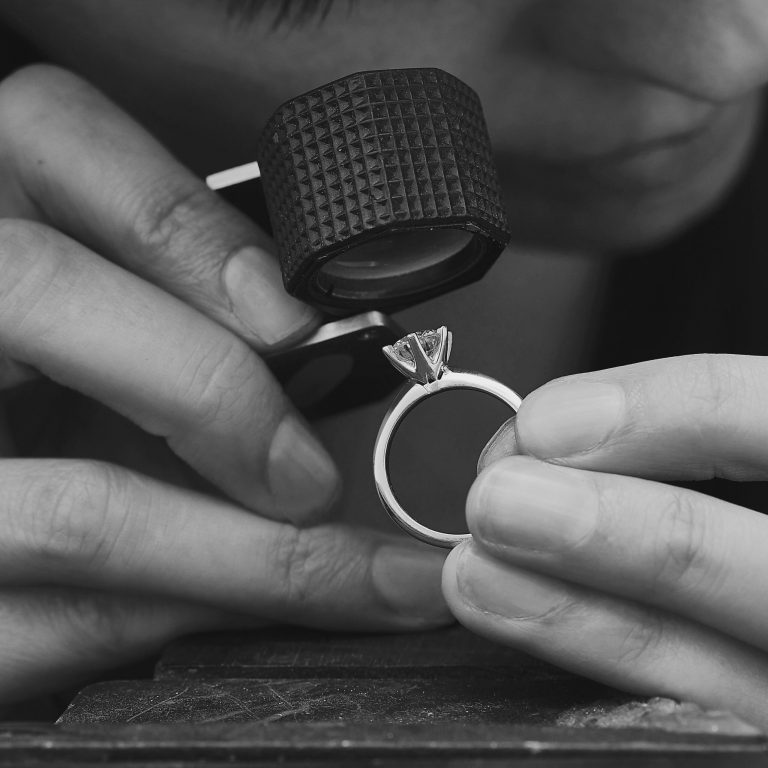
Diamond cutting, or ‘fashioning’ as it is often referred to, is a modern-day art, based on ancient skills and traditional techniques which have been faithfully handed down and carefully developed for over 600 years.

Those who practice the art are known as Diamond Cutters or ‘Diamantaires’.  Their task is to unlock the brilliance and to reveal the beauty hidden within each rough diamond crystal.

The diamond cutting process involves four separate and distinct stages of planning, preparing, shaping, and polishing.  Every stage has a number of individual steps, each being performed by a dedicated, highly trained expert.

Pages: 12NextReturn Top

There are no comments.

SunNuke